
Quick Summary
The most office-friendly quiet home gym picks are compact, low-impact items such as a 1kg electroplated steel dumbbell, a skipping rope needing little room, and under-desk pedal machines. Floor protection and measuring your clear floor space matter as much as the equipment itself.
- The Pure Steel Electroplating Dumbbell starts at $50.44 and suits low-noise strength work.
- The Rope Battle Skipping Rope starts at $89.87 and needs an open swing area of a few metres.
- Measure knee clearance and chair roll-back space before buying any under-desk machine.
- Test noise at working distance, on your actual floor, at the resistance you plan to use.
- A thick, dense mat extending beyond the equipment footprint reduces impact noise and vibration.
Table of Contents
- How We Evaluated Quiet Home Gym Equipment for Office Use
- Quick Comparison: Quiet Home Gym Equipment at a Glance
- Pure Steel Electroplating Dumbbell: Silent Strength for a Desk Corner
- Rope Battle Skipping Ropes: Compact Cardio Equipment for Home Office Use
- Quiet Under-Desk Elliptical and Under-Desk Exercise Equipment: What to Check Before Buying
- Noise-Reducing Exercise Equipment Mats and Floor Protection
- Choosing the Right Setup for Your Room Size, Storage and Budget
- Booking a Consultation to Plan Your Quiet Office Gym
- Frequently Asked Questions
How We Evaluated Quiet Home Gym Equipment for Office Use
Quiet home gym equipment for office use is a narrower category than most buyers expect. We evaluated each item for someone working a few metres from a desk, not a dedicated basement gym.
Manufacturer sound claims vary widely, so test any machine in the room where it will live before committing.
Quick Comparison: Quiet Home Gym Equipment at a Glance
Quick picks depend on your space and training goals.
| Item | Starting Price | Best For | Footprint | Main Limitation |
|---|---|---|---|---|
| Pure Steel Electroplating Dumbbell | $50.44 | Low-noise strength work | Minimal | Single 1kg weight |
| Rope Battle Skipping Rope | $89.87 | Compact full-body conditioning | Minimal | Needs an open swing area |
| Elite Connected Spinner Bike | $999.00 | Indoor cycling with a connected experience | Larger | Requires a dedicated floor area |
| Queen 2.0 Studio Pilates Reformer | $3,199.00 | Serious home Pilates practice | Large | Heavy investment and space demand |
| Queen Studio Pilates Reformer | $2,999.00 | Studio-grade reformer training at home | Large | Heavy investment and space demand |
Pure Steel Electroplating Dumbbell: Silent Strength for a Desk Corner
The Pure Steel Electroplating Dumbbell is the most office-friendly item on this list: pure steel, 1kg, designed for general strength training in a gym, bedroom or living room.
Its electroplated surface resists wear and corrosion. The ergonomic handshake grip is designed for comfort during workouts.
The limitation is obvious: one 1kg weight is light for most adults.
You can view the Pure Steel electroplating dumbbell and check its specifications directly.

Rope Battle Skipping Ropes: Compact Cardio Equipment for Home Office Use
Battle ropes are not usually thought of as office equipment, but this one takes up very little room.
The product description says it works the hands, arms, shoulders, back, core and legs, and suits swimmers, martial artists and players of several ball sports.
The main limitation is space: you need a clear swing area, even if it is only a few metres long.
A skipping rope designed for power training is a useful reference point if you want to see the full specification.

Quiet Under-Desk Elliptical and Under-Desk Exercise Equipment: What to Check Before Buying
Under-desk ellipticals, pedal exercisers and compact steppers are the category most associated with 'quiet home gym equipment for office', and the one where buyers most often get burned. The machine is quiet in the showroom and noisy under a real desk, or it fits the room but not the chair. This section covers how to judge an under-desk machine against your actual desk, chair, floor and call schedule.
Start with desk and chair clearance, not the machine
Measure three things before you shortlist anything:
- Knee clearance: the distance from the front edge of the seat to the underside of the desk. A pedal exerciser pushes your knees forward; if the chair cannot roll back, you will sit twisted, which is worse than not exercising.
- Chair height and leg length: a machine that fits a 5'4" user at a standard desk may not fit a 6'2" user at the same desk. Check the stated user-height range and, if possible, test with your own chair.
Buyers often measure the machine's footprint but not the space their legs need to operate it. The footprint is the smaller number.
Judge noise at working distance, not at the machine
Most product descriptions call under-desk equipment 'quiet' without saying quiet at what distance, on what floor, at what resistance. A pedal exerciser at low resistance on carpet may be inaudible two metres away; the same machine at high resistance on a hard floor can be audible on a call. When assessing any under-desk option:
- Listen from where your microphone sits, not from where you sit.
- Test at the resistance you will actually use, not the lowest setting.
- Test on the floor you will actually use it on. A machine that is quiet on carpet can transmit a low hum through timber.
Check whether it works while seated or standing
Under-desk equipment splits into two use cases, and they are not interchangeable:
- Seated use (pedal exercisers, under-desk ellipticals): designed to be used while typing or on calls. The trade-off is that vigorous pedalling moves your torso, which affects typing stability and posture. Most practitioners find that low-resistance, steady pedalling is compatible with desk work; interval-style pedalling is not.
- Standing use (walking pads, compact treadmills): require a standing desk and a clear stride area. They are better for walking meetings and passive movement than for typing at speed, because walking at any pace introduces vertical motion that most people cannot fully damp while typing.
If your priority is staying on calls and typing, a seated pedal machine is the more compatible choice. If your priority is step count and you have a standing desk, a walking pad is the better fit, but check the deck length and the belt's noise at walking speed.
Floor protection matters more for under-desk equipment than for anything else
Under-desk machines sit close to the floor and transmit vibration directly into it; on timber floors, that vibration travels to the room below more efficiently than airborne noise. A dense rubber mat extending beyond the footprint reduces both impact noise and structure-borne hum. An under-desk machine without a mat is only half-evaluated.
A short buying checklist
Before committing to any under-desk elliptical, pedal exerciser or stepper, confirm:
Pure Steel Home Fitness Electroplating Dumbbell Gym Equipment →
- Under-desk height and knee clearance match your desk and chair.
- The stated user-height range includes you.
- Resistance type is magnetic or otherwise low-contact.
- You have tested or can return it after testing at working distance.
- You have a mat sized to the machine's footprint and your floor type.
- The machine's motion is compatible with typing and calls at the resistance you will use.
If a product page cannot answer points 1-3, that is a signal to keep looking rather than a signal to guess.
Noise-Reducing Exercise Equipment Mats and Floor Protection
Floor protection is the most overlooked factor in a quiet home gym.
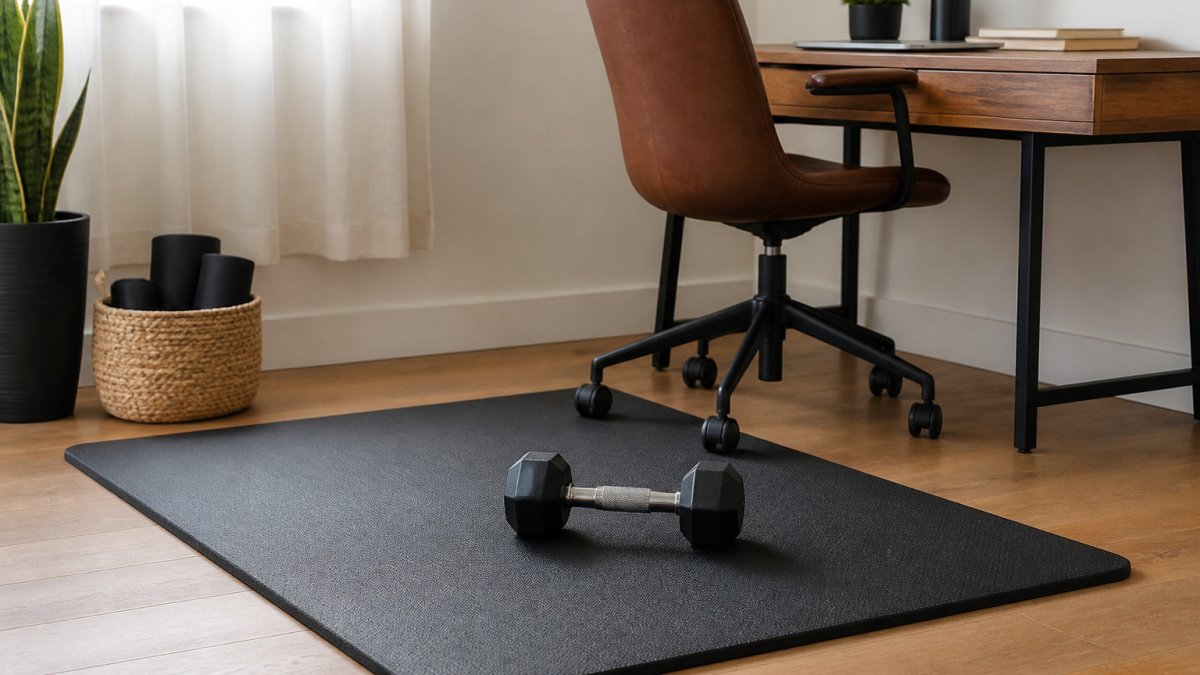
A thick, dense rubber or foam mat reduces both impact noise and vibration transmission. Many buyers find a mat rated for their equipment's weight makes the biggest difference to how a home gym sounds.
When choosing a mat, look for these features:
- Thickness: thicker mats absorb more impact noise.
- Density: denser material resists compression and transmits less vibration.
- Coverage: the mat should extend beyond the equipment's footprint.
Choosing the Right Setup for Your Room Size, Storage and Budget
Most guides tell you to 'measure your space.' This section tells you what to measure, how much clearance each equipment type needs, and how to decide between setups for three common office footprints.
The measurements that decide the setup
For any room, record four numbers before you shortlist equipment:
- Available floor rectangle: the largest clear rectangle you can dedicate, measured wall to wall or desk edge to wall.
- Clearance for movement: the space the user's body needs beyond the footprint, the swing arc for a skipping rope, stride length plus margin for a walking pad, carriage travel for a reformer.
- Storage envelope: the space available when the equipment is not in use, under a desk, in a closet, against a wall.
A common mistake is comparing the equipment's footprint to the room's total area. For more on small apartment home gym layouts, see how different room sizes are arranged. The relevant comparison is footprint plus clearance against the clear rectangle you can actually keep free.
Clearance by equipment type
These are planning ranges, not product specifications, always check the individual product's stated dimensions.
- Dumbbells and small free weights: footprint is minimal; the real requirement is a safe drop zone and a stable surface. A single dumbbell needs a desk-corner's worth of space; a pair for pressing needs room to extend the arms without hitting a wall or monitor.
- Skipping ropes and battle ropes: the rope length sets the requirement. A 2.8-3 m rope needs a clear area roughly that long plus a margin, and a ceiling height that lets the rope arc without hitting a light fitting.
- Under-desk ellipticals and pedal exercisers: footprint is small, but knee clearance and chair roll-back space decide usability.
Three office footprints, three setups
Small corner (roughly 1 m × 1 m of clear floor, desk-adjacent): a dumbbell for light strength work, a mat for floor exercises, and, if the desk and chair allow, a pedal exerciser for seated movement.
Dedicated corner (roughly 2 m × 2 m, can be kept clear): add a skipping rope or a compact stepper, and consider a walking pad if you have a standing desk.
Dedicated room (roughly 3 m × 3 m or larger): a spin bike or reformer becomes viable, but only if you will use it several times a week.
Storage: what actually disappears
'Foldable' and 'storable' are not the same thing. Before buying, ask where the item goes when it is not in use and who moves it:
- Folds flat: some walking pads and benches fold, but a folded walking pad is still heavy and awkward; check the folded dimensions and weight against the person who will move it.
- Slides under furniture: pedal exercisers and some under-desk ellipticals fit under a desk or bed, but check the height against the gap.
- Stands against a wall: mats and ropes store easily; dumbbells need a rack or a stable floor spot.
Budget: match spend to routine, not to ambition
The dumbbell and rope sit at the low end of the catalogue, while the reformers and spin bike are substantial investments. The useful question is not 'what can I afford?' but 'what will I use at least several times a week for a year?'
Booking a Consultation to Plan Your Quiet Office Gym
Choosing equipment for a shared home and a working office involves trade-offs between noise, space and training goals that are easy to get wrong alone. Planning before you buy saves money and avoids the disappointment of equipment that does not fit the room.
Last Updated: October 30, 2026
Frequently Asked Questions
What is the quietest exercise equipment for a home office?
Equipment with magnetic or belt-driven resistance and no exposed chain or flywheel tends to be quietest. Cardio machines like under-desk ellipticals and pedal exercisers are usually quieter than stationary bikes. Strength tools such as dumbbells and battle ropes make less noise when used on a mat. Before buying, check the manufacturer's stated noise level and test it on a hard floor, since flooring changes how much sound carries.
What exercise equipment can fit under a desk?
Measure the clearance under your desk, including the height of the crossbar and the distance from the front edge, before ordering. Pedal exercisers need the least clearance, while ellipticals need more knee and leg room. Keep the workout area clear of cables so you can slide the equipment in and out easily.
Are under-desk ellipticals quiet enough for video calls?
Most under-desk ellipticals are quiet enough for video calls when they run at low to moderate speed on a mat, but noise depends on the drive system and the floor. Vibration through the floor can be picked up by a microphone even when the motor is quiet. Placing the machine on a thick rubber or foam mat reduces both sound and vibration. Test a short call at your normal workout speed before relying on it during meetings.
How can I reduce noise from exercise equipment at home?
Place equipment on a thick rubber or foam mat to absorb vibration and stop it transferring to the floor below. Tighten loose bolts and pedals, since rattling parts are often louder than the motor. Choose low-impact cardio over jumping or running, and avoid workouts during scheduled calls. A dedicated mat under the entire footprint works better than a small pad under one leg.
Can you work out in a small home office without disturbing others?
Yes, if you choose quiet equipment, use a mat and schedule sessions around other people's calls or sleep. Compact options like a rope or a dumbbell can be stored in a corner when not in use, which keeps the room usable for work. Set a fixed workout window and keep the room door closed to limit sound reaching other areas of the home.
