
Last Updated: October 28, 2026
Quick Summary
Choosing durable home workout mats comes down to matching material, thickness, and surface to how you train and what floor you have. Rubber offers the strongest grip and tear resistance, while PVC and TPE are cheaper or lighter but wear faster under heavy loads. Always test a mat on your specific floor before committing.
- Rubber gives the best combination of grip and tear resistance for heavy training.
- EVA foam compresses permanently under heavy point loads like dumbbells.
- Test a small hidden area for 24 hours before placing a rubber mat on hardwood or laminate.
- Wipe the mat with a damp cloth and pH-neutral cleaner after each session.
- Avoid rolling a mat tightly for long periods, since this can leave permanent creases.
Table of Contents
- Why Durability Matters More Than Price in a Home Workout Mat
- Exercise Mat Materials: PVC, TPE, Rubber, and EVA Foam Compared
- Home Workout Mat Thickness: Matching Cushioning to Your Training
- Surface Grip, Tear Resistance, and Long-Term Degradation
- Floor Protection for Home Gym Equipment and Compatibility
- How to Clean an Exercise Mat and Extend Its Lifespan
- Sizing, Portability, and Fitting a Mat Into a Small Apartment
- Booking a Fitting or Choosing Your Mat Setup With IRONINFINITY
- Frequently Asked Questions
Why Durability Matters More Than Price in a Home Workout Mat
Choosing a home workout mat is one of those purchases that looks simple until you own one. A cheap mat that flattens within months, splits along the seams, or starts smelling after a few summer sessions costs more in the long run than a sturdier option you buy once.
Durability shows up in three places. First, the material has to hold its shape under repeated loading, whether that is a burpee session or a heavy deadlift set. Second, the surface has to keep its grip as it wears, since a slick mat is a safety problem. Third, the mat has to survive the way you actually use it, including rolling, storing, and wiping it down.
A mat that compresses unevenly or tears at the edges can undermine a home gym setup, especially in a small space where every piece has to earn its footprint. For more practical tips on keeping your home training setup in good shape, read Maintain Workout Motivation at Home: A Practical Guide.
Exercise Mat Materials: PVC, TPE, Rubber, and EVA Foam Compared
Most home workout mats are made from one of four material families, and each behaves differently over time because of how its polymer structure responds to load, heat, and moisture. Understanding the mechanism behind each material is what separates a mat that lasts three years from one that lasts three months.
PVC (polyvinyl chloride). PVC mats are dense, closed-cell, and inexpensive to produce, which is why they dominate budget shelves. The closed-cell structure resists moisture absorption, so sweat beads on the surface rather than soaking in.
TPE (thermoplastic elastomer). TPE is a copolymer that blends the rubbery feel of elastomers with the processability of plastics. It is lighter than PVC and rubber, often marketed as eco-conscious because it can be recycled in some streams and is frequently produced without phthalates.
Rubber (natural or recycled). Rubber mats offer the best combination of grip and tear resistance because the cross-linked polymer network resists abrasion and returns to shape after compression. Natural rubber grips better when damp, which suits hot yoga and sweaty HIIT.
EVA foam (ethylene-vinyl acetate). EVA is a closed-cell foam that is light, cushioned, and cheap to mold. It feels great for yoga and floor work but compresses permanently under heavy point loads, a dumbbell left in place will leave a dent that never fully recovers.
| Material | Structure | Best For | Main Failure Mode | Durability Outlook |
|---|---|---|---|---|
| PVC | Closed-cell, plasticized | Budget, general use | Plasticizer migration, stiffening, cracking | Moderate |
| TPE | Thermoplastic elastomer | Lightweight, low-odor | Filler-driven slickness, compression | Moderate to good (quality-dependent) |
| Rubber | Cross-linked elastomer | Heavy training, grip | Weight, odor, finish reactions | High |
| EVA foam | Closed-cell foam | Yoga, cushioning | Permanent compression, edge tearing | Moderate |
Verify any specific durability claims against the manufacturer's stated specifications before buying, since material grades differ widely between products. A "rubber" mat and a "rubber" mat can differ by density, filler content, and cure quality, and those differences decide how long the mat lasts.
Home Workout Mat Thickness: Matching Cushioning to Your Training
Thickness decides how much cushioning you get and how stable the mat feels underfoot. Thin mats give you better ground feel for balance work and lunges, while thicker mats soften impact for jumping and floor exercises. The trade-off is that thicker mats are harder to roll, store, and keep flat. A very thick, soft mat can also wobble under heavy weights, which reduces stability in exactly the moments you need it most.
A useful rule is to think about what hits the mat. If you mostly stretch or do bodyweight core work, a moderate thickness is enough. If you jump, drop weights, or do floor-based circuits, lean toward thicker, denser material so the cushioning holds up over repeated impacts rather than bottoming out.
Surface Grip, Tear Resistance, and Long-Term Degradation
Surface grip and tear resistance are where cheap mats usually fail first. Grip comes from the surface texture and the material's composition, and it can fade as dust, oil, and sweat build up or as the surface wears smooth. Tear resistance matters most at edges and seams, where repeated rolling and dragging concentrates stress.
Long-term degradation is the angle most buyers never test. Expect some change over time: UV exposure can discolor and stiffen certain materials, heat can soften them, and compression from heavy equipment leaves permanent marks. A mat that feels fine after a month may show surface wear after a year of daily use. When you compare products, look for stated warranty terms and any independent durability testing, and be wary of listings that promise longevity without evidence.
Floor Protection for Home Gym Equipment and Compatibility
A good mat protects your floor and the equipment you place on it, but the right mat depends heavily on what is underneath it.
Carpet. Carpet is soft and forgiving but unstable underfoot.
Hardwood. Hardwood scratches and dents under point loads, and some rubber backings can react with certain finishes over time, leaving a haze or discoloration.
Concrete. Concrete is durable but abrasive and cold. It will wear through thin foam quickly, and dust from unfinished concrete degrades grip. A thicker rubber mat or interlocking rubber tiles handle concrete best, and a sealed concrete floor reduces dust.
Tile. Tile cracks under concentrated impact and grout lines create uneven pressure points. A mat with enough thickness to bridge grout lines, rubber or dense PVC, prevents point loads from reaching the tile. Avoid thin foam, which transmits impact straight through.
Laminate. Laminate is prone to scratching and water damage at seams. A mat with a moisture-resistant backing and no abrasive underside protects it, and wiping up sweat promptly matters more on laminate than on sealed concrete.
Compatibility also matters with the rest of your gear. Heavy dumbbells need a surface that will not shift or compress into an uneven dip. Rubber-coated dumbbell sets reduce noise and impact, which pairs well with a mat that absorbs the rest. Pairing the right floor covering with the right weights keeps both your flooring and your neighbors' ceilings in better shape, and matching the mat to your specific floor type is the step most buyers skip. To see how home gear can be kept from damaging your living space, read how to keep home gym equipment from ruining apartment decor.
How to Clean an Exercise Mat and Extend Its Lifespan
Regular cleaning is the cheapest way to make a mat last longer. After each session, wipe the surface with a damp cloth and a mild, pH-neutral cleaner. Harsh solvents and abrasive scrubbers can strip the texture and degrade the material, so avoid them. Let the mat air dry fully before rolling it, since trapped moisture encourages odor and mildew.
Every few weeks, give the mat a deeper clean and check the edges and seams for early wear. Store it flat or loosely rolled away from direct sun and heat. Rolling it tightly for long periods can leave a permanent crease, so unroll it periodically. Sweat and oil are the main enemies of grip, so keep the surface as dry as you can between uses.
Sizing, Portability, and Fitting a Mat Into a Small Apartment
A mat that is too small leaves your hands or feet off the surface during floor work, while one that is too large eats living space. Measure the area you plan to use, then add a little margin for movement. For a guide showing how to arrange the space around your mat, see small apartment home gym layout ideas. In a small apartment, consider a roll-up or foldable mat that stores against a wall, or interlocking tiles you can remove when not training.
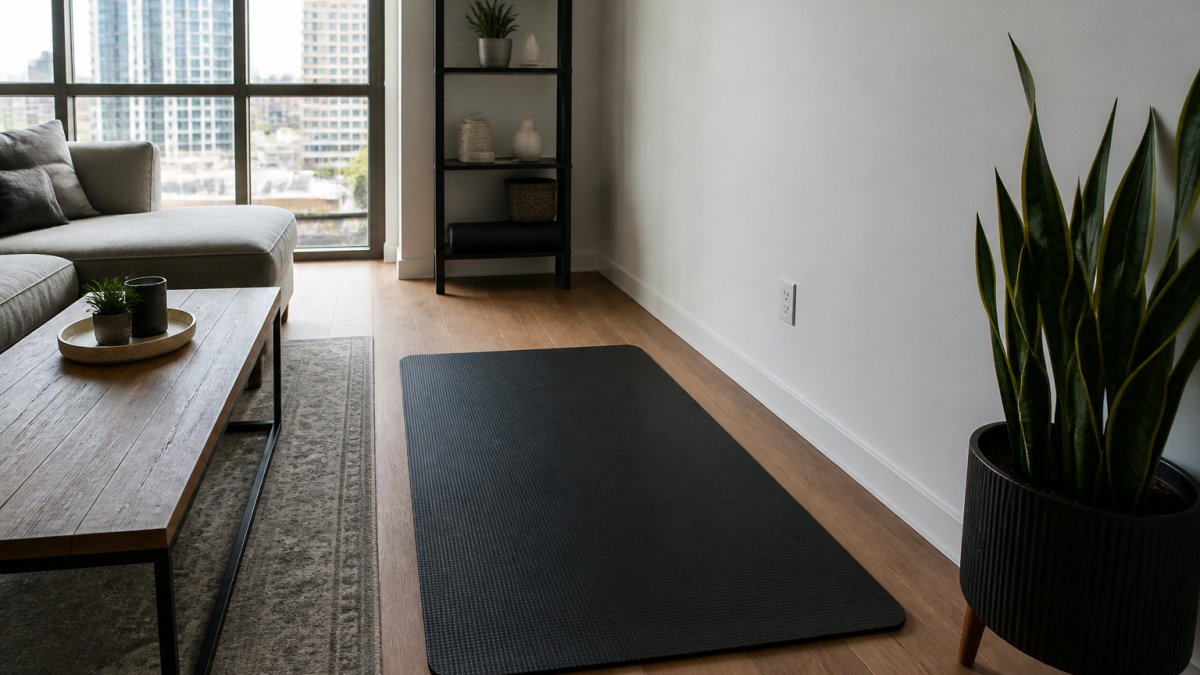
Portability is worth weighing against stability. Lighter mats are easier to move but may shift during heavy work, while heavier mats stay put but take effort to store. A bright corner with a rolled mat leaning against a wall, beside a wooden floor and a small plant, is often the most practical setup for a compact home gym. For storage ideas that keep a mat and equipment tidy and out of the way, see minimalist home gym storage solutions.
Booking a Fitting or Choosing Your Mat Setup With IRONINFINITY
Every training space is different, and the right mat depends on your floor, your equipment, and the kind of training you do most. You can explore IRONINFINITY's space-efficient home gym solutions for your own setup. For current pricing, check the IRONINFINITY website directly.
Frequently Asked Questions
What should I look for in a durable home workout mat?
Look at density, tear resistance, closed-cell construction, and the quality of the surface coating. A durable mat keeps its shape under repeated loading, resists tearing at the edges, and does not flatten or crack after months of use. Check whether the manufacturer states the material and thickness clearly, and whether the surface resists moisture and sweat.
What material is best for a home gym mat?
The right material depends on the training. Closed-cell EVA foam is lightweight and cushions well for bodyweight work. Rubber and TPE offer strong grip and tear resistance for heavier equipment and floor work. PVC is durable and easy to wipe clean but can be less comfortable underfoot. Choose based on the exercises you do most, the floor under the mat, and how often you move it.
How thick should an exercise mat be for home workouts?
Thin mats of about 4 to 6 mm suit stretching and light floor exercises. Mats around 10 to 15 mm give enough cushion for most bodyweight training and kneeling movements. Heavier lifting areas usually need denser, thicker flooring to absorb impact and protect the subfloor. Thicker is not always better, because very soft mats can reduce stability during balance and standing exercises.
How do I stop a workout mat from slipping on the floor?
Choose a mat with a textured, high-friction surface and a base that grips the floor. Rubber bases typically hold better on hard floors than smooth vinyl backing. Placing the mat on a clean, dry floor and avoiding loose rugs underneath also reduces movement. If a mat still slides during dynamic training, a thicker or heavier base often improves stability.
How do I clean and maintain a home workout mat?
Wipe the surface after each session with a damp cloth and a mild, pH-neutral cleaner. Avoid harsh solvents, bleach, or abrasive pads, which can degrade the surface and reduce grip. Let the mat air dry fully before rolling or storing it to prevent odor and microbial growth. Clean the underside periodically to remove dust and grit that can wear the base.
How long should a home workout mat last?
Service life depends on material, thickness, traffic, and care. A well-made mat used several times a week can last for years, while lightweight foam mats under heavy equipment may compress or tear sooner. Signs of wear include flattening, loss of grip, cracking at the edges, and persistent odor. Inspecting the mat regularly helps you decide when replacement makes sense.
Do I need a mat under home gym equipment?
In most homes, yes. A dense mat protects floors from scratches, dents, and noise when dumbbells, racks, or cardio machines are used. It also stabilizes equipment and reduces vibration transmitted to the floor below, which matters in apartments. Check whether your flooring type, such as hardwood or laminate, needs a specific underlay or protective surface for the equipment you plan to use.
