
Table of Contents
- Home Gym vs Gym Membership Cost: The Real Numbers
- Home Gym Equipment Cost: What You Actually Spend
- Break-Even Point: When Your Investment Pays Off
- Best Home Gym Equipment for Small Spaces
- Multi Gym Pros and Cons for Home Workouts
- Beyond Cost: Privacy, Consistency, and Your Training Goals
- Conclusion: Is Home Gym Equipment Worth It for You?
- Frequently Asked Questions
Last Updated: October 11, 2026
Home Gym vs Gym Membership Cost: The Real Numbers
Comparing home gyms to gym memberships requires more than weighing upfront costs against monthly fees. A gym membership typically involves monthly fees, while home gym equipment demands an upfront investment but eliminates recurring payments. The real question: which delivers better value for your situation? The answer depends on three variables: total equipment cost, monthly membership fee, and your actual usage frequency. Most people underestimate the third factor, a home gym that sits unused is infinitely expensive, as is a gym membership you don't visit.
Home Gym Equipment Cost: What You Actually Spend
Home gym equipment worth the investment depends on what you buy and whether you account for full cost of ownership. A basic starter setup (dumbbells, bench, bands) involves an initial investment; a comprehensive gym requires a more significant one. Most people fall between these extremes but ignore hidden expenses that accumulate over time.
Breaking Down Equipment Tiers by Training Goal
Strength training: Adjustable dumbbells, a weight bench, resistance bands, and optional barbell/plates enable compound lifts and progressive overload without dedicated space.
General fitness: Resistance bands, lighter dumbbells, a yoga mat, and bodyweight tools offer variety with minimal footprint, ideal for apartments.
Cardio-focused: A treadmill or bike plus dumbbells and flooring. This requires dedicated space.
Comprehensive multi-purpose: A barbell/rack, dumbbells, cardio machine, bench, pull-up bar, and flooring. This demands significant space.
Total Cost of Ownership: Beyond the Purchase Price
Over five years, factor in: Maintenance, warranties and repairs, flooring, and delivery/installation.
A home gym can offer financial advantages over a gym membership in the long run, if you use it consistently.
Matching Equipment to Realistic Usage
Before spending, match equipment to your actual habits: If you've never stuck with a routine, start with basics. If you travel frequently, consider skipping expensive cardio machines. If you've abandoned equipment before, consider renting or borrowing first.
What matters more than the total number is understanding what you're actually purchasing and whether it aligns with your training goals, available space, and realistic usage patterns. Equipment that sits unused is infinitely expensive, regardless of the purchase price.
Break-Even Point: When Your Investment Pays Off
The break-even point is where total home gym investment equals cumulative gym membership cost. The calculation depends on local membership prices, usage frequency, and total cost of ownership.
The Basic Break-Even Formula
Formula: Total equipment cost ÷ monthly membership fee = break-even months. After this point, a home gym can become financially superior, if you use it consistently.
Real-World Scenarios: How Break-Even Shifts
Budget scenario: A home gym can reach a break-even point against a membership. Premium scenario: A more comprehensive home gym can also reach a break-even point against a premium membership. With inflation: Accounting for potential membership inflation can shift the long-term advantage to home gym ownership.
The Usage Frequency Multiplier
Usage frequency is the strongest predictor of payoff. High usage (frequent workouts): Break-even accelerates; cost per visit drops rapidly. Moderate usage (regular workouts): Break-even occurs over a longer period; the decision is genuinely uncertain. Low usage (infrequent workouts): Break-even extends significantly; a gym membership may be a better choice.
Depreciation and Equipment Lifespan
Equipment choice dramatically affects true cost of ownership. Some equipment types, like dumbbells and benches, tend to retain more value than others, such as treadmills and multi-gym machines.
Hybrid Scenarios: Home Gym + Occasional Gym Access
A hybrid approach, minimal home setup plus occasional gym access, can optimize cost and variety. This works well for those with limited space, inconsistent schedules, or uncertainty about commitment.
When Break-Even Doesn't Matter
Break-even calculations become irrelevant if: you have dedicated space and budget, you value privacy over community, you need specific equipment your gym lacks, or you're paying for unused services.
Best Home Gym Equipment for Small Spaces
Home gym equipment worth the investment in a small apartment requires a different approach than someone with a dedicated garage or basement.
Space constraints force prioritization. You can't have everything, so you need equipment that delivers maximum training value in minimum footprint. This is where space-efficient solutions become critical.
The best equipment for small spaces includes:
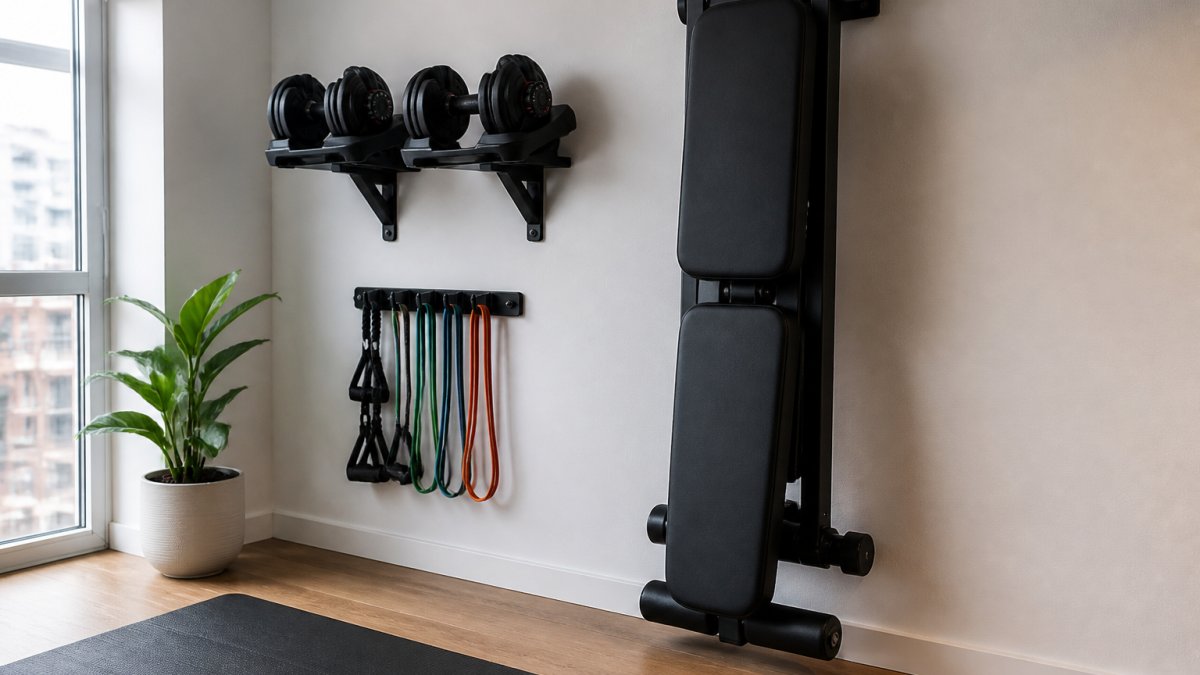
- Adjustable dumbbells: Replace 15+ individual dumbbells with one compact set
- Resistance bands: Virtually no storage footprint; exceptional versatility
- Wall-mounted pull-up bar: Uses vertical space, not floor space
- Collapsible weight bench: Folds away when not in use
- Suspension trainer: Weighs ounces; mounts anywhere
Many people overlook how equipment integrates into daily living. At IRONINFINITY, we've worked with clients in 600-square-foot apartments who successfully maintained consistent training routines. The difference between those who succeeded and those who didn't wasn't the equipment itself, it was whether the setup felt like a natural part of their home rather than an intrusion.
A home gym that requires 20 minutes of setup before each workout gets skipped. Equipment that lives in a corner, ready to use, gets used.
Consider the noise factor in small spaces. A treadmill in an apartment above neighbors creates friction. Resistance training with dumbbells is quiet. Jumping exercises are not. Your equipment choice should respect your living situation.
Multi Gym Pros and Cons for Home Workouts
Multi-gym machines (all-in-one equipment that combines multiple exercise stations) present an interesting trade-off for home gym equipment worth the investment.
Pros:
- Consolidates multiple exercises into one machine, saving floor space
- Provides guided movement paths, which can reduce injury risk for beginners
- Requires minimal setup between exercises
- Often includes built-in weight stacks that eliminate the need for separate dumbbells
Cons:
- Takes up significant floor space despite being "all-in-one"
- Limits exercise variety compared to free weights and resistance bands
- Often creates awkward movements that don't match your body proportions
- Difficult to resell; depreciation is steep
- Most multi-gym machines are designed for average body dimensions, which doesn't work for everyone
The fundamental problem with multi-gym machines is that they force your body to move along predetermined paths. Free weights and resistance bands allow you to adjust the movement to your individual mechanics. For serious strength training, this matters. For basic fitness maintenance, it matters less.
Multi-gym machines work well for people with specific situations: someone returning to training after injury, someone with limited space who wants guided resistance training, or someone who values simplicity over exercise variety. They don't work well for people with ambitious training goals or those who need flexibility in their movements.
Beyond Cost: Privacy, Consistency, and Your Training Goals
The financial comparison between home gym and membership is only part of the decision. Three non-financial factors often matter more than the numbers.
Privacy and comfort influence consistency more than most people realize. A home gym eliminates the social pressure of a commercial facility, which is good if that pressure discourages you, and bad if it motivates you. Some people thrive with the energy of a gym floor. Others find it distracting or intimidating.
Training goals determine equipment needs. Someone training for a powerlifting competition needs heavy barbells and a squat rack. Someone doing general fitness maintenance can accomplish their goals with resistance bands and bodyweight exercises. The equipment that's worth the investment for one person is overkill for another.
Consistency is where home gyms excel. No commute. No waiting for equipment. No scheduling around facility hours. These friction points eliminate thousands of workouts annually across gym-goers. A home gym removes them.
Conversely, a gym membership provides accountability through environment and community. Some people need that structure. A home gym requires internal motivation, which is harder for some and easier for others.
Conclusion: Is Home Gym Equipment Worth It for You?
Home gym equipment is worth the investment when three conditions align: your training goals match what you can accomplish with the equipment you purchase, you'll actually use it consistently, and the break-even point occurs within a realistic timeframe for your situation.
It's not worth the investment if you're buying equipment hoping it will motivate you, if your space constraints make the setup impractical, or if the upfront cost strains your budget beyond comfort.
The decision ultimately comes down to your specific circumstances, not a universal answer that applies to everyone. Someone in a small apartment with a tight budget and inconsistent training history should probably maintain a gym membership. Someone with dedicated space, clear training goals, and the discipline to work out alone should probably invest in a home gym.
At IRONINFINITY, we help you design a space-efficient home gym that integrates seamlessly into your living environment. Our tailored approach focuses on equipment that matches your actual training goals and fits your available space, eliminating the common mistake of buying equipment you won't use. Research on home fitness adoption shows that equipment integration into living space is the strongest predictor of consistent use suggests that thoughtful design matters more than equipment quantity.
The best home gym is the one you'll actually use. That's worth the investment.
Frequently Asked Questions
How much money do you need for a good home gym equipment setup?
A functional home gym equipment starter set can range from basic resistance bands and adjustable dumbbells to complete multi-gym systems. The investment depends on your training goals and space. Equipment options offer foundational strength training capability, while premium options provide durability, aesthetic integration, and expanded workout variety. Visit IRONINFINITY to explore tailored setups designed for your specific needs and space constraints.
Is a home gym cheaper than a gym membership in the long run?
Home gym equipment worth the investment depends on your usage and timeframe. Initial upfront costs are substantial, but over time, most home gym setups can become more economical than continuous monthly membership fees. Long-term savings can increase significantly if you maintain consistent training and avoid equipment depreciation through proper maintenance and quality purchases.
What are the main disadvantages of having a home gym?
Common drawbacks include limited equipment variety compared to commercial gyms, space requirements and storage challenges in smaller homes, initial upfront costs, and potential motivation loss without the social atmosphere of a fitness facility. Noise considerations matter in apartments, and equipment maintenance becomes your responsibility. However, hybrid approaches, combining home workouts with occasional gym visits, can mitigate these constraints while preserving long-term cost savings.
Are multi gyms any good for home workouts?
Multi-gym systems offer excellent value for home workouts when space and budget align with your training goals. They consolidate multiple exercise options into one compact footprint, reducing storage needs and simplifying setup. The trade-off is less equipment variety than a full commercial gym. Multi gyms work best for strength training fundamentals and general fitness; serious athletes may need supplementary free weights or specialized equipment. Quality and durability vary significantly, so prioritize reputable manufacturers.