
Quick Summary
The best workout leggings fabric is usually a blend of polyester or nylon with 10% to 25% spandex, chosen by how you train. Nylon-rich blends feel smoother and recover well, while polyester-rich blends resist moisture and hold color through washing. Always check opacity with a squat test before buying.
- Most leggings pair a base fiber of 75% to 90%, polyester or nylon, with 10% to 25% spandex.
- Mid spandex, around 15% to 20%, is the most common all-round zone for training leggings.
- Nylon-rich blends feel smoother and recover shape well after stretching.
- Polyester-rich blends resist moisture and hold color better through repeated washing.
- Machine wash cold and hang dry, since heat accelerates loss of stretch and pilling.
Table of Contents
- What Makes Workout Leggings Fabric Perform
- Nylon vs Polyester Leggings: Which Holds Up Better
- Moisture-Wicking Fabric for Workout Clothes in Practice
- Squat-Proof Leggings Fabric and How to Test It
- Leggings Fabric Composition: Fiber Percentages and Construction
- Matching Fabric to Your Workout, Climate and Care Routine
- Choosing Your Next Pair of IRONINFINITY Leggings
- Frequently Asked Questions
Which Fabric Is Best for Workout Leggings?
Last Updated: November 2, 2026
What Makes Workout Leggings Fabric Perform
Choosing the best workout leggings fabric comes down to four things: stretch, moisture management, opacity, and durability. Leggings should be judged the way a serious lifter judges a training shoe: the fabric has to move with you, not against you.
Most leggings are built from a blend of a base fiber and an elastic fiber. The base fiber, usually polyester or nylon, provides strength and surface behavior. The elastic fiber, typically spandex (also sold as elastane or Lycra), provides the stretch that lets you squat, lunge, and recover without restriction.
A common mistake is judging leggings by feel in the store. Softness matters, but a fabric that feels great on a hanger can still turn sheer under load. Check how it behaves when stretched, not only how it feels at rest.
Nylon vs Polyester Leggings: Which Holds Up Better
Nylon and polyester are the two fibers you will see most often in performance leggings. Both can work well. They differ in how they handle stretch, feel, and wear.
Nylon tends to feel smoother and softer against the skin, and it recovers its shape well after stretching. Polyester is generally more resistant to moisture and holds color well through repeated washing. Neither is universally superior, so the right choice depends on how you train and how you care for your clothes.
Watch out: Blends with a high elastic content can lose recovery over time, especially with frequent heat from the dryer.
Moisture-Wicking Fabric for Workout Clothes in Practice
Moisture-wicking fabric moves sweat from the skin to the outer surface of the fabric, where it can evaporate. Polyester and nylon are both hydrophobic fibers, which is why they are common in activewear. Cotton, by contrast, absorbs sweat and stays wet, which is why it feels heavy and cold during a workout.
In practice, wicking matters most during high-output sessions such as HIIT, running, or heavy lower-body training. Look for a fabric that stays comfortable at the end of a set, not only at the start.
Squat-Proof Leggings Fabric and How to Test It
Squat-proof is a term you will see on many product pages, but it is worth checking rather than trusting. The simplest test is to hold a light source behind the fabric and look for see-through areas. Then perform a deep bodyweight squat in the leggings, ideally in a well-lit room, and check the seat and thighs in a mirror.
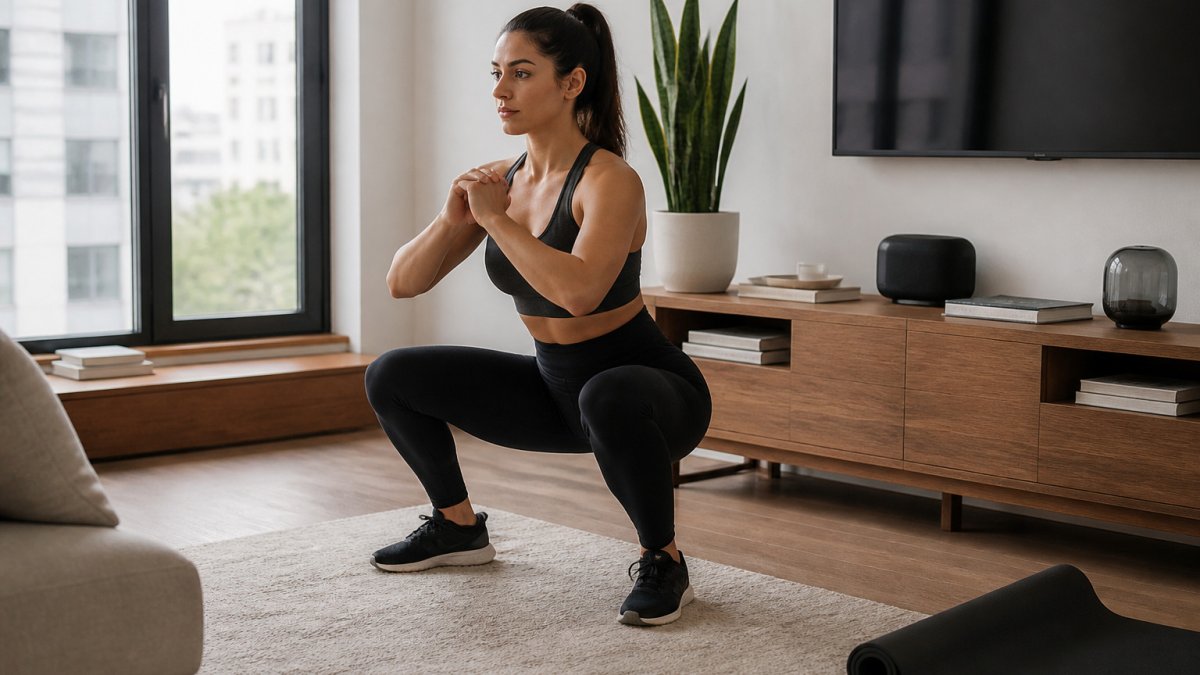
Opacity depends on fiber density, weight, and how far the fabric stretches. A fabric that looks opaque at rest can thin out at full stretch, so the squat test is the one that counts.
!A woman in dark high-rise leggings performing a deep bodyweight squat in a bright, minimalist apartment living room
Leggings Fabric Composition: Fiber Percentages and Construction
Fiber percentages on a care label tell you more than marketing copy, but only if you know how to read them. The two numbers that matter most are the base fiber share and the elastic fiber share. A common performance legging sits somewhere between 75% and 90% base fiber (polyester or nylon) and 10% to 25% spandex. Within that range, small shifts change the hand feel and the recovery behavior.
As a practical rule of thumb:
- Lower spandex (roughly 10-15%): firmer, more structured feel; often more durable and more opaque, but less forgiving through deep ranges of motion.
- Mid spandex (roughly 15-20%): the most common all-round zone for training leggings; balances stretch, recovery, and coverage.
- Higher spandex (roughly 20-25%+): softer, more second-skin feel and greater stretch, but recovery can fade faster with heat and repeated washing, and opacity under load becomes more variable.
Base fiber choice shifts the profile too. Nylon-rich blends tend to feel smoother and recover shape well; polyester-rich blends tend to resist moisture and hold color through washing. Neither is universally better, the blend ratio tells you what the fabric is optimized for.
Go Again Women's Full Length Legging →
Construction matters as much as the recipe. Three knit variables change performance:
- Knit density: tighter, denser knits are generally more opaque and more durable, but can feel warmer and less breathable.
- Fabric weight (GSM): heavier fabrics resist show-through better under stretch; lighter fabrics feel cooler but need denser construction to stay opaque.
- Panel placement: mesh and ventilation panels add breathability but reduce coverage, so they work best on areas that do not need full opacity (backs of knees, waistband interiors) rather than the seat and upper thighs.
A useful habit is to compare the label against the feel: if a fabric claims high stretch but feels thin and loose-knit, test opacity before trusting it. Construction is where many "squat-proof" claims succeed or fail.
ASTM International standards for textile testing
Matching Fabric to Your Workout, Climate and Care Routine
No single fabric is ideal for every training style, climate, and care routine. The useful move is to decide which trade-offs you are willing to accept, then choose the blend and construction that fit. Use the matrix below as a starting point, then confirm with the label and a squat test.
| Priority | Fabric/construction direction | Trade-off to accept |
|---|---|---|
| Maximum opacity under load | Heavier weight, denser knit, mid-to-high spandex, darker colors | Warmer, slower to dry |
| Fast drying for hot, humid training | Polyester-rich base, lighter weight, mesh ventilation panels | Less opacity under deep stretch; mesh reduces coverage |
| Soft, second-skin feel | Nylon-rich base, higher spandex share | Recovery can fade faster with heat; opacity varies more |
| Durability through repeated washing | Denser knit, moderate spandex, polyester-rich base | Firmer hand feel, less stretch |
| Sensitive skin comfort | Smooth nylon-rich face, flat seams, minimal mesh | Often higher cost and slightly warmer |
| Low-impact and everyday wear | Softer blends, lower spandex, lighter weight | Not built for high-impact opacity demands |
Workout type sets the baseline. High-impact training (HIIT, running, heavy lower-body lifting) rewards strong elastic recovery and opacity under stretch, so lean toward denser knits and mid-to-high spandex. Yoga and low-impact work reward softness and freedom of movement, where a nylon-rich, higher-stretch blend feels better. For cold-weather training, a slightly denser knit adds warmth but slows drying; for hot, humid conditions, prioritize polyester-rich, lighter fabrics with ventilation panels placed away from high-opacity zones.
Care routine is the variable most people ignore. Heat is the main enemy of elastic recovery: hot water and machine drying accelerate loss of stretch and can worsen pilling. A practical default is machine wash cold and hang dry. If you routinely use hot water or a dryer, favor denser knits and moderate spandex shares, which tolerate heat better than high-stretch, lightweight fabrics.
Sustainability adds another trade-off. Recycled polyester is a common option, and all synthetic stretch fabrics shed microfibers during washing. A wash bag and lower wash frequency reduce shedding and extend garment life, durability and care are part of the material choice, not separate from it.
Finally, test before you commit. Whatever the label says, hold the fabric to a light source, then perform a deep squat in a well-lit room and check the seat and thighs. That test, combined with the fiber percentages and knit density, tells you more than any single marketing claim.
Choosing Your Next Pair of IRONINFINITY Leggings
If you want a full-length option built for demanding movement, the Go Again Women's Full Length Legging features squat-proof, sweat-wicking fabric, medium compression, a high-rise waistband, and a 26" inseam.

If you prefer a shorter cut, the Go Again Women's Cropped Leggings Length 21" offers squat-proof, sweat-wicking construction in a cropped length.

For a broader look at training bottoms that fit your routine, see how to choose high waisted workout shorts for women. And if you are building a full training wardrobe, supportive full length leggings for training is a useful companion read.
Whichever you choose, check the fiber content, test the opacity under a squat, and follow the care label. That combination will tell you more than any single product claim.
Frequently Asked Questions
Which fabric is best for exercise?
For most workouts, a polyester or nylon blend with about 10 to 20 percent spandex gives the best combination of stretch, moisture management and durability. Polyester tends to resist pilling and holds its colour through repeated washing, while nylon is softer and more elastic. Choose based on the activity: high-intensity training benefits from the stretch recovery of a higher spandex share, while long sessions in warm conditions favour fabrics with strong sweat-wicking. Check the fiber percentages on the care label before buying.
Is nylon or polyester better for workout leggings?
Neither is strictly better. Nylon is softer, more elastic and feels smoother against the skin, which suits yoga and low-impact training. Polyester is more resistant to abrasion, dries quickly and keeps its shape after many washes, which suits frequent gym sessions. Both perform well as blends with spandex. If opacity and durability through repeated washing matter most, polyester often has the edge; if comfort and stretch come first, nylon is usually preferred.
What fabric makes leggings squat-proof?
Squat-proof leggings rely on a tightly constructed knit with enough fabric weight and density that the material does not thin when stretched. Blends of nylon or polyester with spandex, typically a heavier knit, resist see-through exposure at the thighs and seat during deep movements. Test by squatting in front of a bright light or mirror before wearing them to a class. Fabric construction matters as much as fiber choice, so a well-made blend can outperform a thinner fabric of the same composition.
How much elastane should workout leggings contain?
Most workout leggings use between 10 and 20 percent elastane or spandex. This range gives reliable four-way stretch and good recovery without making the fabric feel tight or restrictive. Higher percentages improve compression and shape retention but can reduce breathability and increase the risk of the fabric losing elasticity over time. For yoga and flexibility work, a lower share with softer nylon can feel more comfortable, while high-intensity training usually benefits from the upper end of the range.
