
Quick Summary
The best home gym equipment for most buyers is an all-in-one unit like the All-in-One Home Gym, Power Rack w/ Smith Machine & Functional Trainer, priced at $3,499.00. For limited space, a compact option like the Commercial Squat Rack at $1,499.00 fits better. Choose based on your room size and the exercises you do most.
- The All-in-One Home Gym lists a footprint of about 72″L × 82″W × 88″H.
- The Commercial Squat Rack costs $1,499.00 and includes integrated weight storage.
- The Selectorized Functional Trainer uses dual 250 lb weight stacks on a 2:1 pull ratio.
- Smart features are unconfirmed for most machines, so check the listing before assuming app tracking.
Table of Contents
- How We Tested and Scored Home Gym Equipment
- Best All-in-One Home Gym for Full-Body Training
- Best Home Gym Equipment for Limited Space
- Best Full Body Workout Machine for Home
- Strength Machines and Accessories Compared
- Cardio and Pilates Equipment: Which Fits Your Routine
- Best Smart Home Gyms in 2026
- Choosing Your IRONINFINITY Setup Next
- Frequently Asked Questions
How We Tested and Scored Home Gym Equipment
Last Updated: November 22, 2026
Choosing home gym equipment in 2026 means weighing space, build quality, and how well a machine suits your training. This review explains how we scored home gym equipment against the factors that matter most to a home buyer.
Most buyers start with price, but cost alone tells you little. A cheap machine that rattles, wobbles, or never gets used is poor value. We judged each item on six points: footprint and ceiling clearance, build construction, range of exercises, fit for a home setting, adjustment speed, and long-term ownership. Where a product listing gives a measurable figure, we report it; where a figure is missing, we say so rather than estimate it.
A few plain rules shaped the scoring:
- Footprint and clearance: Can it fit a room without taking over the floor, and does it leave enough ceiling height for the intended lifts?
- Construction: Are the frame, cable, and weight stack described as commercial-grade, and what does the listing say about steel gauge, cable rating, and warranty?
- Versatility: How many exercises does one unit support, and does it cover the movements a home lifter actually performs?
- Home suitability: Does it fit a living room, bedroom, or garage, and what installation or anchoring does it require?
- Adjustment speed: How quickly can a user change weight or station position between sets?
- Long-term ownership: What accessories, maintenance, and replacement parts are required, and how available are they?
We state specs only where the product listing gives them. Where a figure is missing, we say so rather than estimate it.
What we measured and how
Our review is based on published product specifications. For each product we record:
- Footprint: the listed dimensions in inches, converted to the minimum clear floor area a buyer needs, including space to load plates or move a bench.
- Ceiling clearance: the listed height plus the headroom needed for the intended movement (for example, standing presses or pull-ups).
- Stability indicators: frame material, base design, and whether the listing specifies floor anchoring or weight-storage ballast.
- Noise and vibration indicators: drive type (belt vs. chain, cable vs. plate-loaded), brake type, and whether the listing mentions rubber feet or dampening.
- Setup and adjustment time: the number of steps described for changing weight, switching stations, or folding the unit, and whether the listing gives a pin, lever, or tool-based mechanism.
- Exercise count: the number of distinct movements the listing explicitly supports, not the theoretical maximum.
Where a listing omits a figure, we mark it as unconfirmed and do not fill the gap with an estimate. That is why some rows in our comparison carry fewer numbers than others.
Scoring
Watch out: a listing that advertises a weight stack capacity without stating the pull ratio can mislead buyers about the actual resistance at the handle, so we treat unstated ratios as unconfirmed rather than assuming a 2:1 system.
ASTM home fitness equipment safety standards
Best All-in-One Home Gym for Full-Body Training
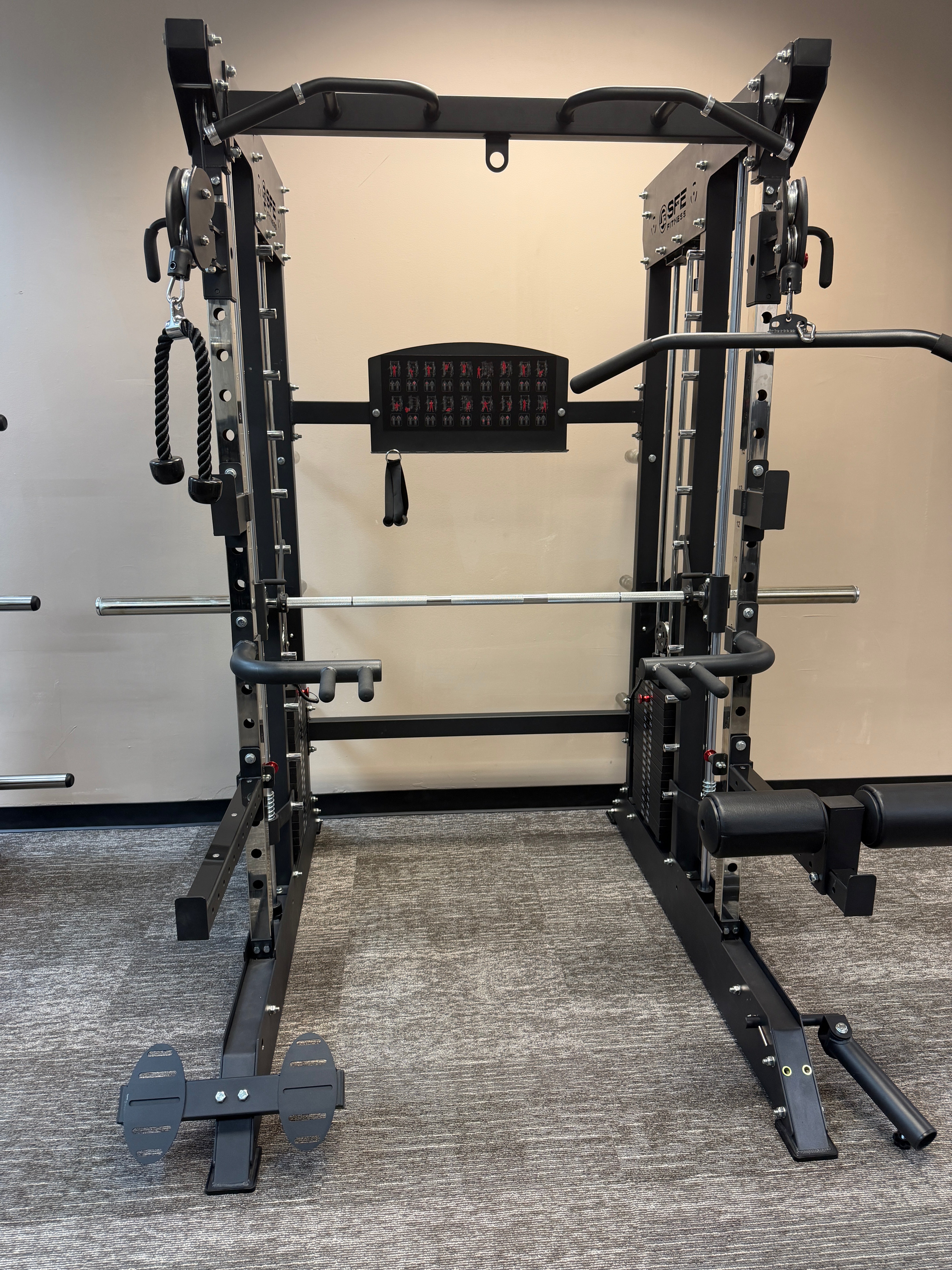
If you want one machine to cover most of your training, the All-in-One Home Gym, Power Rack w/ Smith Machine & Functional Trainer is our top pick. It combines a power rack, Smith machine, and functional trainer, with dual 220 lb weight stacks.
The Smith machine guides barbell lifts such as squats and bench presses, which suits solo training. The functional trainer's pulley system handles cable crossovers, lat pulldowns, and rows. It ships with a 7 ft Olympic bar, safety bars, J-hooks, and several handles.
Its listed footprint is approximately 72″L × 82″W × 88″H. Priced at $3,499.00, it is a serious investment, best suited to someone who will use every station.
Best for: lifters who want a full-body setup in one footprint. Skip if: you have a small apartment or only plan to train with dumbbells.
Best Home Gym Equipment for Limited Space
Limited space changes the calculation. A compact machine that fits a corner is often more useful than a large system that dominates the room. The Commercial Squat Rack w/ Safety Bars, J-Hooks & Weight Storage at $1,499.00 includes integrated weight storage, which keeps plates off the floor.
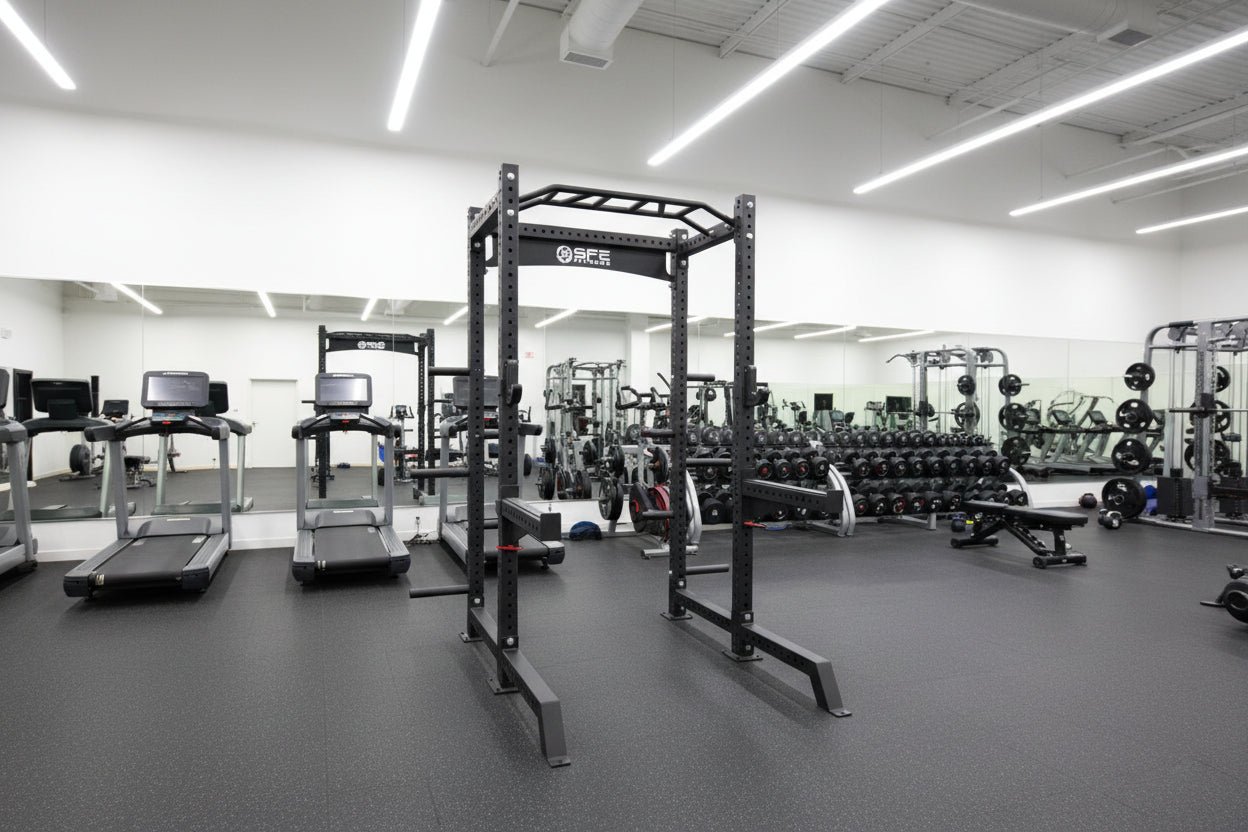
The rack includes a 7 ft Olympic barbell, safety catches, and adjustable J-hooks. It is a plate-loaded unit, so you will need weight plates in addition to the rack.
Best for: strength lifters who want a sturdy rack with storage. Skip if: you want a machine with no plates to buy.
Best Full Body Workout Machine for Home
For a full-body session without a power rack, the Selectorized All-in-One Functional Trainer Home Gym w/ 2x250lb weight stacks is built around cable-based training. Dual 250 lb stacks on a 2:1 pull ratio give you a wide resistance range for pulling and pressing movements. With its broad range of cable movements, the trainer can anchor a versatile home workout space when you plan room for its footprint and clear cable paths.
Its selectorized design means you change weight with a pin rather than loading plates, which speeds up transitions between exercises.
Best for: users who prefer cable work and quick weight changes. Skip if: you need a barbell rack for heavy squats.
Strength Machines and Accessories Compared
Single-purpose machines fill gaps that all-in-one systems leave. The table below compares the strength machines in this review.
| Product | Price | Weight Stack | Best For |
|---|---|---|---|
| Selectorized Adjustable Chest / Shoulder Press | $2,499.00 | 200 lb | Chest and shoulder press |
| Selectorized Leg Extension & Prone Leg Curl Combo | $2,499.00 | 250 lb | Quads and hamstrings |
| Pure Steel Electroplated Dumbbell | $50.44 | N/A (1 kg) | Light strength work |
| Rope Battle Skipping Rope | $89.87 | N/A | Conditioning |
Price
The chest press has an adjustable starting position and a 200 lb selectorized stack. The leg combo switches between seated leg extensions and prone leg curls.
The dumbbell and battle rope are low-cost accessories.
Cardio and Pilates Equipment: Which Fits Your Routine
Our catalog also includes cardio and Pilates equipment. The Elite Connected Spinner Bike is priced at $999.00.
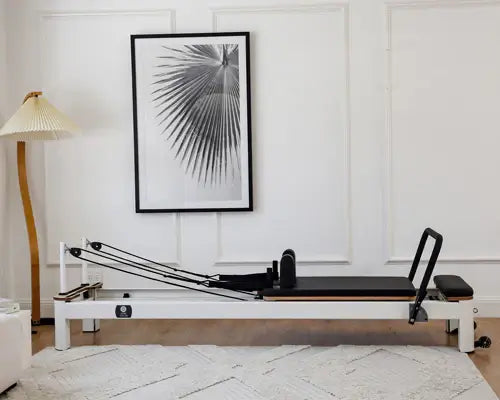
For Pilates, the Queen Studio Pilates Reformer is priced at $2,999.00 and includes a reformer box and jumpboard. The Queen 2.0 Studio Pilates Reformer is priced at $3,199.00, with a box, jumpboard, and platform included.
Best Smart Home Gyms in 2026
Smart home gym equipment in 2026 usually means one of three things: a machine with built-in sensors and an app, a machine that pairs with a third-party training app, or a connected cardio unit that reports workout data. The catalog does not list connected or app-based features for most of these machines, so we cannot confirm smart functions for them. The Elite Connected Spinner Bike is the one item described as connected, but the listing does not detail its app or sensor features. Check the full listing before assuming any digital tracking.
What to verify before buying smart equipment
- App and subscription model: Does the machine require a paid subscription for its main features, and what happens to the machine if you cancel? A machine that becomes a basic resistance tool without the app is a different value proposition than one that keeps its core function.
- Sensor type and data: Does the listing name the sensors (for example, load cells, encoders, or heart-rate receivers), and does it state which metrics are captured?
- Compatibility: Does it pair with a phone, tablet, or TV, and which operating systems and fitness apps are supported?
- Connectivity: Wi-Fi and Bluetooth versions, and whether workouts are stored locally or only in the cloud.
- Updates and support: How long the manufacturer commits to app updates, and whether the machine has a manual mode if the app is discontinued.
Getting connected training from mechanical equipment
Most of the strength machines in this review are mechanical, and that is not a drawback for connected training. A common pattern is to pair a mechanical machine with a tablet or phone running a general training app, using the machine for resistance and the app for programming and logging. For the All-in-One Home Gym and the selectorized functional trainer, the pin-based weight selection makes it easy to follow app-prescribed sets without loading plates. For the Spinner Bike, the belt drive and adjustable handlebars suit interval work, and you can use a separate heart-rate strap or watch if the built-in sensors are unconfirmed.
What we could not confirm
We could not confirm app names, subscription prices, sensor accuracy, or firmware support windows for any product in this review. Those details change frequently and are often updated on the product page rather than in a static review. Before buying, open the current listing and look for a compatibility section, a subscription terms page, and a support or warranty page that mentions software.
Watch out: a machine marketed as "connected" may only mean it has a Bluetooth-enabled console, not that it streams classes or tracks resistance automatically, so confirm the specific feature you want rather than the label.
Bluetooth SIG fitness machine service overview
Choosing Your IRONINFINITY Setup Next
Start with the room you have. Add accessories only once the main machine is chosen.
If you are unsure, pick the product that matches the exercises you do most. A full-body buyer should look at the All-in-One Home Gym first. A buyer with limited space should start with the Squat Rack or a single selectorized machine.
Get a home setup that fits your routine and your space. Explore the IRONINFINITY range and build a plan around the equipment you will use most.
Frequently Asked Questions
What is the best home gym equipment in 2026?
The best choice depends on the space and the training goal rather than one universal pick. For full-body strength work, the All-in-One Home Gym with Power Rack, Smith Machine and Functional Trainer covers a wide range of exercises, with dual 220 lb weight stacks and a listed footprint of about 72 by 82 by 88 inches. Selectorized machines and the Commercial Squat Rack with weight storage are compact options to consider. Measure your room before deciding.
Is an all-in-one home gym worth it?
An all-in-one home gym is worth it if you want several stations, such as a power rack, Smith machine and functional trainer, without buying each separately. The IRONINFINITY All-in-One Home Gym is priced at 3499.00 and includes a 7 ft Olympic bar, safety bars, J-hooks, lat bar, T-bar and tricep handles.
Which home gym equipment is best for a full-body workout?
The All-in-One Home Gym is the strongest option for full-body training because its functional trainer covers cable crossovers, lat pulldowns, rows and tricep pushes, while the Smith machine and power rack handle squats, bench presses and shoulder presses. Pairing it with the Selectorized Adjustable Chest / Shoulder Press (200 lb stack, 1,000 lb capacity) and the Selectorized Leg Extension and Prone Leg Curl Combo (250 lb stack) fills in dedicated upper and lower body work. Battle ropes add conditioning for the whole body.
What should I look for when buying home gym equipment?
Check the frame and stack specifications first, since a commercial-grade steel frame and a solid weight stack determine how long the equipment lasts under regular use. Confirm the footprint against your room, including the clearance needed to use each station. Look at the included accessories, because some systems ship with bars and attachments and others do not. Compare the total cost, including any accessories you will need to add later, and check the warranty and delivery timeline, which can run longer for custom colours.
