
Quick Summary
To choose home gym flooring, first list the activities you will do and check what sits under the floor, then match thickness and density to your heaviest training. Rubber suits heavy lifting, foam suits light work, and concrete slabs need moisture testing before any flooring goes down.
- List your activities first, since lifting, cardio and stretching place different demands on the floor.
- Density usually matters more than thickness for protecting the subfloor under heavy equipment.
- Use 15-20 mm dense rubber for general strength training with dumbbells and a bench.
- Test a concrete slab for moisture with a plastic sheet for 24-48 hours before installing rubber.
- Avoid placing dense equipment directly on carpet, since it compresses unevenly and leaves marks.
Table of Contents
- What Home Gym Flooring Needs to Do
- Home Gym Flooring Types Compared: Rubber, Foam, Vinyl and Carpet
- Home Gym Flooring Thickness and Density: What Works for Your Equipment
- Choosing the Best Flooring for Home Gym Over Concrete
- Choosing the Best Flooring for Home Gym Over Carpet
- Horse Stall Mats for Home Gym Use: When They Make Sense
- Book Your Room Plan With IRONINFINITY
- Frequently Asked Questions
What Home Gym Flooring Needs to Do
Last Updated: November 24, 2026
Choosing how to choose home gym flooring starts with one question: what will the floor have to absorb? Compact home gyms for small apartments depend on the floor more than most buyers expect. A good home gym floor protects the subfloor from dropped weights, cushions joints during floor work, keeps equipment from sliding, and stays clean enough to live with. Each job points toward a different material.
Start by listing your activities. Lifting, cardio machines, bodyweight training and stretching each place different demands on the surface. Heavy dumbbell work needs thick impact protection. Stretching needs softer, easy-to-clean material you can lie on comfortably. A machine that vibrates needs a dense base to dampen movement.
Then check what sits underneath. A concrete slab, a wooden floor over joists and a carpet over a pad each behave differently under load, and each needs its own protection. Rooms above other flats also raise noise concerns, so a floor that absorbs vibration matters as much as one that absorbs impact.
Keep these four functions in mind as you read the rest of this guide:
- Impact protection: absorbs the energy from dropped weights
- Stability: keeps equipment from rocking or shifting
- Subfloor protection: shields the floor beneath from scratches, dents and moisture
- Ease of cleaning: resists sweat, chalk and dust in a small room
Home Gym Flooring Types Compared: Rubber, Foam, Vinyl and Carpet
Most home gym owners choose between rubber, foam, vinyl and carpet. Rubber offers the best impact protection and durability for heavy lifting. Foam is lighter and softer, suited to light training and stretching. Vinyl is easy to wipe clean but offers less cushioning. Carpet is the weakest option for a home gym, because sweat and heavy equipment wear it down quickly and it holds odor.
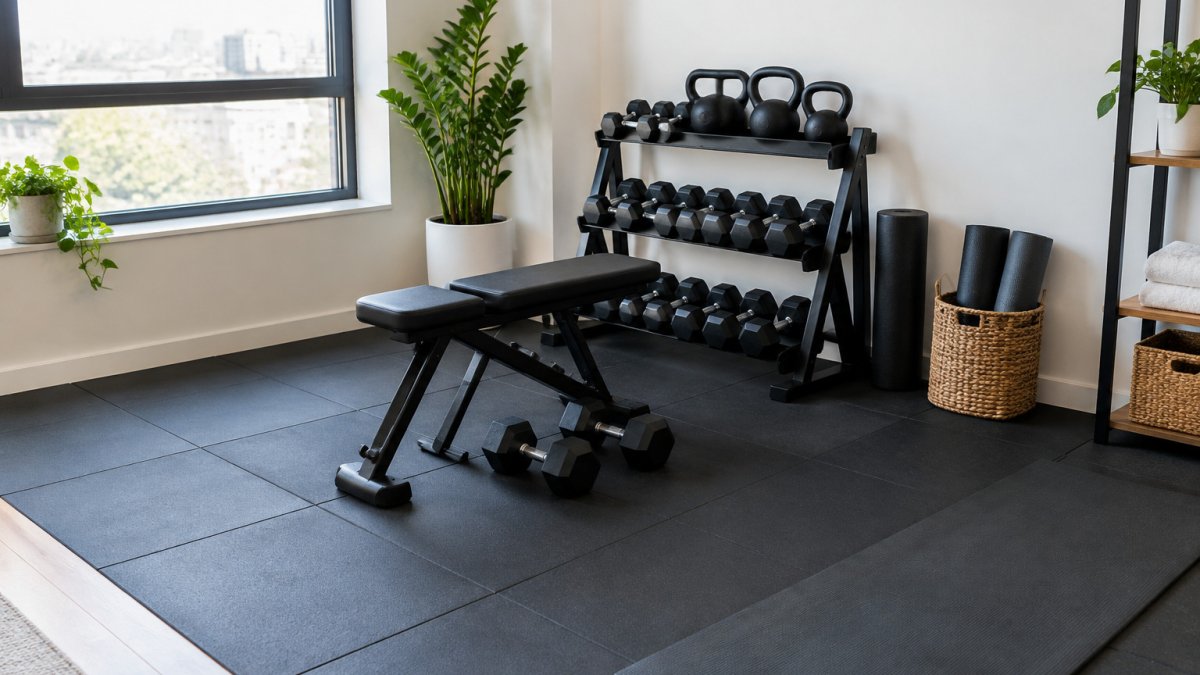
Rubber rolls, tiles and mats
Rubber is the most common choice for serious training. It absorbs the force of dropped weights and holds heavy equipment steady. Rubber comes as rolls, interlocking tiles and single mats. Rolls cover large areas with few seams. Tiles are easier to fit in an irregular room and can be replaced one at a time. Mats suit a single zone, such as under a rack or bench.
Check that the rubber is dense and low-odor before buying, since cheap recycled rubber can smell strongly during the first weeks.
Foam and interlocking tiles
Foam tiles are light, soft and quiet, and they suit yoga, stretching and bodyweight workouts. They are less suited to heavy weights, because foam compresses and can crack under point loads. Interlocking foam tiles are easy to lay and to rearrange in a small apartment, but seams can separate if the room moves or the tiles are too thin.
Home Gym Flooring Thickness and Density: What Works for Your Equipment
Thickness and density work together, and confusing them is the most common buying mistake. Thickness is the cushion you can measure with a tape. Density is how much that cushion resists compression under load. A 12 mm foam tile and a 12 mm rubber tile are the same thickness but behave nothing alike: the foam compresses to a fraction of its height under a loaded barbell, while the rubber barely deflects. For a home gym, density usually matters more than thickness, because a dense floor of moderate thickness protects the subfloor better than a thick, soft floor that bottoms out.
Use these working ranges as a starting point, then confirm the manufacturer's stated thickness and density before buying:
- Yoga, stretching, and bodyweight work: 6-10 mm foam or a thin rubber mat. You want cushion for knees and elbows without a squishy surface that makes balance poses unstable.
- Cardio machines and light dumbbell work: 8-12 mm dense rubber or rubber-topped vinyl. The goal is stability under a treadmill or rower plus easy cleaning.
- General strength training with dumbbells and a bench: 15-20 mm dense rubber tiles or rolls. This range absorbs incidental drops and keeps a bench from sliding.
- Olympic lifting, powerlifting, and dropped weights: 20-25 mm+ dense rubber, often as a platform with a wooden center section. Thin foam or soft rubber will deform permanently and transmit impact to the slab.
Density is usually expressed as a weight per volume figure or a Shore hardness rating. Ask for the spec sheet rather than trusting the product photo. A dense rubber layer of moderate thickness often protects the subfloor better than a thick, soft layer, because the soft layer compresses fully and passes the impact through.
Match the floor to your heaviest activity, not your average one. Light cardio and yoga can use thinner, softer material. Dropping weights from overhead needs thicker, denser rubber. Heavy equipment such as a squat rack or treadmill needs a stable base so it does not rock, and a soft floor under a rack leg is worse than no floor at all because the leg sinks unevenly and the frame twists.
Measure the equipment footprint and add space for movement, then check that the chosen floor can carry the load without deforming. Point loads matter more than total weight: a 300 kg rack spread over four small feet concentrates far more force per square inch than the same weight spread across a platform. A dense tile under each foot, or a plywood base under the rack, spreads that load. Ask for product specifications before buying, including the stated thickness, density, and compression set, and test a single tile under your heaviest equipment before covering the whole room.
Watch out: a floor that feels firm underfoot can still compress permanently under a loaded barbell, so judge density by the spec sheet and a loaded test, not by hand feel alone.
The article matches floor thickness to the kind of training you do, so this table summarises those working ranges.
| Training type | Suggested thickness | Floor type |
|---|---|---|
| Yoga, stretching, bodyweight | 6-10 mm | Foam or thin rubber mat |
| Cardio machines, light dumbbells | 8-12 mm | Dense rubber or rubber-topped vinyl |
| General strength training | 15-20 mm | Dense rubber tiles or rolls |
| Olympic lifting, dropped weights | 20-25 mm+ | Dense rubber platform |
Choosing the Best Flooring for Home Gym Over Concrete
Concrete is a common base in garages and basements. It is solid and level but cold, hard and damp-prone, and the moisture problem is the one most home gym owners discover too late. Concrete slabs can wick moisture from the ground and release it as vapor. If you lay rubber directly on a damp slab, the moisture can become trapped under the rubber, which may lead to mold and odor, so treat slab moisture as an early decision.
Test the slab before you buy flooring. Tape a 60 cm × 60 cm square of clear plastic sheet to the concrete with all edges sealed, leave it for 24-48 hours, and check for condensation on the underside or dark damp patches on the slab. A simple calcium chloride test kit gives a more precise reading of moisture vapor emission. If the slab is damp, do not install rubber or foam directly over it.
Mitigate before installing. Options, in rough order of effort:
- Vapor barrier or moisture-resistant underlay: a polyethylene sheet or a dedicated underlay with a vapor barrier layer, lapped and taped at the seams, run up the wall slightly at the edges.
- Raised subfloor or interlocking base tiles: these create an air gap that lets moisture dissipate and also add a little cushioning and thermal separation from the cold slab.
- Sealing the slab: a concrete sealer slows vapor transmission but is not a substitute for a barrier under rubber in a damp basement.
Rubber rolls and interlocking rubber tiles both work well over concrete once moisture is controlled. The dense surface protects the slab from dropped weights and keeps equipment from sliding. For heavy racks and machines, check the slab itself and consider spreading the load with a plywood base or platform under the feet. If you bolt equipment down, use anchors rated for concrete.
Temperature and comfort also matter on concrete. A bare slab pulls heat from your feet and hands, and rubber alone stays cold. A rubber-topped underlay or a thin foam layer under the rubber makes floor work more comfortable without sacrificing stability. Keep the flooring clear of the garage door track and any floor drains, and leave a small expansion gap at walls so the rubber does not buckle in heat. Because comfort and clearance depend on the surface beneath your equipment, choosing garage flooring also means weighing how each option handles warmth, stability, and the demands of a working space.
Watch out: sealing a damp slab and then covering it with rubber can trap moisture and cause odor and mold, so always test first and use a barrier rather than relying on sealer alone.
Choosing the Best Flooring for Home Gym Over Carpet
Installing a home gym over carpet can be risky. Carpet compresses unevenly, so equipment can wobble, and heavy weights can crush the fibers and leave permanent marks.
If you must train on carpet, use a thick rubber mat or a rigid platform underneath. Avoid placing dense equipment directly on the carpet. Where you can, move the training zone to a hard floor.
Horse Stall Mats for Home Gym Use: When They Make Sense
Horse stall mats are thick, rubber-based mats made for animal stalls. Some home gym owners use them because they are heavy, durable and inexpensive per square foot. They can work well for a garage or basement with heavy-duty use.
They are less suitable for a finished apartment. They are often rough-textured, can be heavy to move, and may carry an odor. Check whether the mat is made for people-use surfaces before buying, and confirm it suits your room.
Book Your Room Plan With IRONINFINITY
Choosing the right home gym floor is easier when you know your room size, subfloor and equipment footprint. At IRONINFINITY, we help you plan a compact layout that fits your space and workout style. Contact IRONINFINITY to request a room plan or ask about flooring for your setup. Prices depend on quantity, delivery and the flooring you choose, so request a quote for current figures.
Frequently Asked Questions
What type of flooring is best for a home gym?
For most home gyms, rubber flooring is the most practical choice. Rubber rolls and tiles absorb impact from dropped weights, resist scratches and slip, and protect both the floor and the equipment. Foam tiles suit light cardio and stretching, while vinyl and carpet work better for low-impact training. Match the material to your heaviest activity, then confirm the thickness and density suit your equipment before buying.
Is 3/8 inch gym flooring thick enough?
A 3/8 inch (about 10 mm) rubber floor works well for light to moderate training, including dumbbells, bodyweight work and most cardio machines. For heavy barbell lifting or frequent dropped weights, many people choose 3/4 inch or thicker, because thicker rubber absorbs more impact and protects the subfloor better. If your equipment is heavy or concentrated on small feet, check the manufacturer's loading guidance before you decide.
Are horse stall mats suitable for a home gym?
Horse stall mats can work in a home gym, particularly in garages and basements where durability matters more than appearance. They are thick and heavy. However, they can be rough-textured and are not always suited to finished living spaces. Indoors in living spaces, rubber tiles or rolls usually offer a better balance of comfort, noise control and finish.
What is the best flooring for a home gym over concrete?
Over concrete, use a material that handles moisture and gives impact protection. Rubber tiles or rolls on top of a moisture barrier are a common choice. Test the slab for moisture before installing, since concrete can release moisture upward and damage some flooring. Interlocking rubber tiles can be paired with a vapor barrier underneath.
